WILD CLAY: IMMERSIVE APPROACHES
TO CREATIVE FLOURISHING
As human beings functioning as potters, we center ourselves and our clay.
A capacity to yield is strengthened in the potter who does not merely use his material to certain ends, but who yields up his soul as well as his hands and his intelligence to his love of the clay.
We are transformed, not by adopting attitudes toward ourselves but by bringing into center all the elements of our sensations and our thinking and our emotions and our will: all the realities of our bodies and souls.
M.C. Richards, Centering
MINDFULNESS AND CLAY
A ONE OR TWO-DAY WORKSHOP
For more information on offering this at your ceramics studio, reach out at: poesiapottery@gmail.com
Participants will engage with the basic tenets of Mindfulness Based Stress Reduction while learning the art of centering and working with clay on the pottery wheel. Through this medium of clay, we will explore the possibilities of mindfulness as stated by MBSR founder Jon Kabat-Zinn: “Mindfulness is awareness that arises through paying attention, on purpose, in the present moment, non-judgementally.”
In this space, we will utilize the pottery wheel to enjoy the practice of claymaking while learning new methods to embody concepts of Mindfulness and Creative Flourishing such as awareness, insight, focus, belonging, acceptance, and resilience.
WILD CLAY: AN IMMERSIVE APPROACH
TO CREATIVE FLOURISHING
Wild Clay can be offered as a one-day workshop, a first-year seminar and one, two and four-week summer courses
This course was developed through the support of the National Art Strategies Creative Community Seed Grant, the Arthur F. Kinney Center for Interdisciplinary Renaissance Studies’ Renaissance of the Earth Teaching Fellowship and the UMass Amherst Studio Arts Department.
WILD CLAY TWO OR FOUR-HOUR SESSIONS
Tan Brook: A Mindful Exploration of Wild Clay, Creative Practice and the World Around Us
The two or four-hour Wild Clay workshop can be adapted for groups and events from across campus. Possible presentations include: “Welcome to the U” First week of classes activity, Family and Friends Weekend, class projects, staff or faculty retreats, Fine Arts Center community events, or a conference activity.
TWO OPTIONS FOR STARTING LOCATION AND DURATION
1. THE CAMPUS POND/UNIVERSITY MUSEUM OF CONTEMPORARY ART (TWO-HOUR SESSION)
Tea Talk: Introduction to the Tan Brook and its transformations as it flows through the natural and manmade environments that make up the University of Massachusetts Amherst campus.
A talk on the “wild” glacially deposited terracotta clay found on the Tan Brook, and its importance in preserving the geological history of the Connecticut River Valley.
A mindfulness-based creative making session with wild clay.
Discussion of artist George Trakas’ work “Isle of View,” which reshaped the way the university community interacts with the campus pond island. Collaborative visioning session of how this space might be reimagined based on priorities including community, nature, and accessibility.
Presentation of ideas from the visioning session over snacks.
POST-SESSION FOLLOW-UP: Each participant’s making session clay project will be fired and mailed to them along with written materials related to the Wild Clay session.
2. TAN BROOK GLACIAL VARVE CLAY DEPOSIT (FOUR-HOUR SESSION)
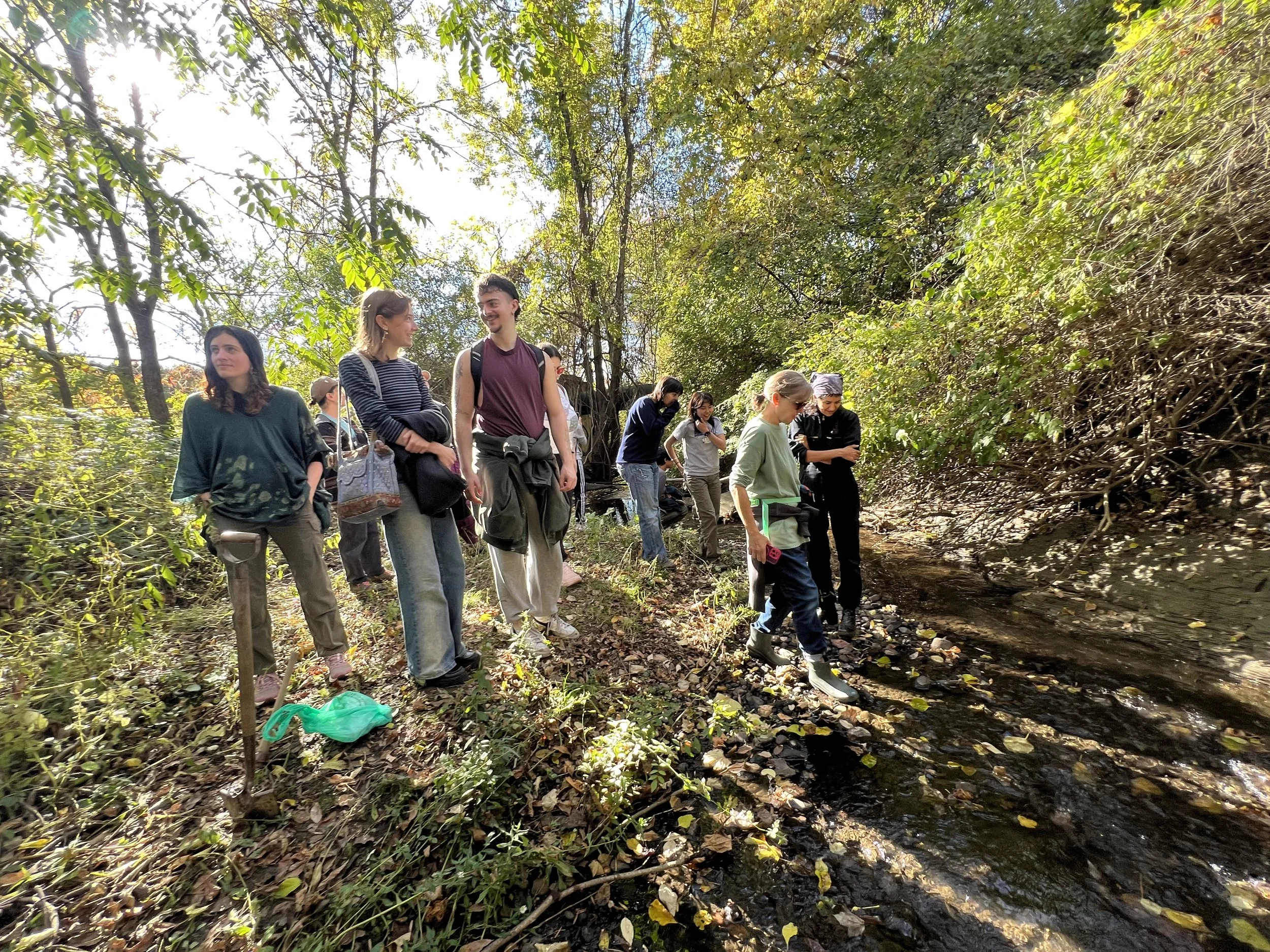
This workshop invites participants to reconnect with earth-based practices through fieldwork and hands-on making as we move across a variety of natural and manmade landscapes on campus. Meeting at an area of the Tan Brook with one of the most geologically-significant clay deposits in western Massachusetts, we’ll learn methods to identify and ethically harvest wild clay, then take a guided walk across campus with Rozy Bathrick (College of Natural Sciences) to better understand our local ecology, linking cycles of soil, water, forest, and geological change. Our walk concludes at the University Museum of Contemporary Art by the campus pond with a clay workshop, using local terracotta. As we walk through campus and traverse geological time, we’ll explore how traditional clay practices forge connections with the natural world, grounding us in both the deep past and living present.
Participants will meet at Parking Lot 12, which is adjacent to the Tan Brook.
Introduction to the glacial varve clay deposit on Tan Brook and a discussion of: the varve’s importance in preserving the geological history of the Connecticut River Valley; methods of harvesting “wild” clay and its transformation into a clay body for creative practice; the changing nature of the brook as it flows through the University of Massachusetts Amherst campus.
A walk through the riparian environment surrounding Tan Brook and a talk on the flora and fauna that live there. Walk ends at the Bromery Center for the Arts and the campus pond.
A mindfulness-based creative making session with wild clay.
Discussion of artist George Trakas’ work “Isle of View,” which reshaped the way the university community interacts with the campus pond island. Collaborative visioning session of how this space might be reimagined based on priorities including community, nature, and accessibility.
Presentation of ideas from the visioning session over snacks.
POST-SESSION FOLLOW-UP: Each participant’s making session clay project will be fired and mailed to them along with written materials related to the Wild Clay workshop.
WILD CLAY FIRST-YEAR SEMINAR SYLLABUS AND WEEKLY PLAN
1-Credit Weekly Course
The Tan Brook runs directly through the center of the UMass Amherst campus. It flows beneath the Bromery Center for the Arts, is the source of the campus pond, and is diverted underground through manmade channels before re-emerging on the northwestern edge of campus where its banks reveal one of the best examples of the “wild” glacial varve clay that tells a tale of geological history in the Connecticut River Valley.
Using the Tan Brook as an anchor point, Wild Clay will explore our campus surroundings through the lenses of creative writing, scientific exploration, history, architecture and ceramics.
The pedagogy of Wild Clay is informed by mindfulness, flourishing and wellness approaches developed by such institutions as the University of Massachusetts Amherst, the Brown University Center for Mindfulness, and the University of Wisconsin-Madison Center for Healthy Minds.
Course objectives include:
Familiarizing students with their campus
Engagement with Flourishing tenets such as Awareness, Connection, Insight and Purpose through creative writing, campus exploration and collaborative projects as a means of supporting student wellness and success
Learning diverse methods of engagement with the world (scientific, artistic, historical, etc.) that will prepare students for more intensive study in their chosen fields
WEEKLY SCHEDULE
WEEK ONE
Introductions, Course Syllabus Discussion, Creative Writing session (one thing I’ve noticed on campus)
WEEK TWO
Meeting at the Campus Pond, discussion of George Trakas’ “Isle of View,” and the human impact on the Tan Brook. Creative Writing (how does this space feel to me).
WEEK THREE
Meeting at the Tan Brook “wild” glacial varve clay deposit. Discussion with geologist and naturalist about the wild riparian watershed environment formed by Glacial Lake Hitchcock. Tilemaking session with wild brook clay. Background printouts from Ed Klekowski’s essay A New Drainage History for Glacial Lake Hitchcock: Varves, Landforms and Stratigraphy
WEEK FOUR
Readings and discussions about the social, environmental, historical and creative impacts of natural resource harvesting.
WEEK FIVE
A visit to the University Museum of Contemporary Art’s archives to explore George Trakas’ public art work “Isle of View,” which was installed on the campus pond. Presentation of fired wild clay tiles.
Writing and photo assignment: Think about an area of campus you would like to re-design, and how would you do it? Photograph the area.
WEEK SIX
Collaborative drawing and writing session that brings together all of the different areas of campus “re-design” on large sheets of paper.
WEEK SEVEN
The natural world. A visit to the Natural History Collections in Morrill Science Center. QUESTIONS: How do you think the natural and built environments impact your own experience at the University of Massachusetts Amherst. What are some of the native species that co-exist with the campus population?
ACTIVITY: Drawing from the Natural History Collections.
WEEK EIGHT
Pairing two to three students who will research one native species and create a five-minute presentation about it. Exploring methods of presentation including slides, podcast, or a zine.
WEEK NINE
Continue work on the five-minute presentation. In-class collaboration sessions.
WEEK TEN
Presentations.
WEEK ELEVEN
Thanksgiving Week
WEEK TWELVE
Transferring images onto ceramics (wheelthrown terracotta flowerpots or mugs made by professor Michael Medeiros). Learning the technique of screenprint transfers of imagery and words from Week Six’s collaborative drawing and writing session and Week Seven’s visit to the Natural History Collections.
WEEK THIRTEEN
Last day of classes, party and presentation of ceramics.
WILD CLAY SUMMER COURSE
COURSE OBJECTIVES
Wild Clay utilizes the Tan Brook running through the University of Massachusetts Amherst campus as a lens to explore creative practice, material, environment, community, and history . This hands-on course will include daily making sessions, technical and conceptual discussion, and presentation of completed work.
We will:
Develop knowledge of clay and clay bodies, and other natural materials used in ceramics. We will particularly focus upon the terracotta glacially deposited low-fire clays typically found in Massachusetts, and learn approaches to glazing and firing them.
Learn about where to find and responsibly harvest wild clay, and how such harvesting impacts the surrounding environment.
Process clay to prepare it for creative usage.
Learn wheelthrowing and handbuilding techniques to make functional, sculptural and interactive works.
Begin to explore and create a conceptual and technical framework for artistic practice that includes materials to include in a college admissions portfolio.
WILD CLAY CONSISTS OF FOUR WEEK-LONG SECTIONS:
RAW MATERIALS
An introduction to clay and other natural materials used in ceramics. What does it mean to harvest clay responsibly, and what impact does the harvesting of any natural resource have upon the natural environment? How do we determine what materials we will use, and how we will use them both individually and as members of a community?
CREATIVE PRACTICE
What do you want to make, and how will you do it? What matters to you conceptually, technically, and holistically. Using mindfulness and flourishing practices, we will explore what it means to develop a healthy, rewarding lifelong creative practice.
FINISH AND FIRE
The transition from clay to ceramic. This week will focus on different approaches to refining, glazing, and firing.
REVELATION AND PRESENTATION
How do you want your work to exist in the world? This segment offers an opportunity to present coursework through exhibition, performance, and documentation for a creative portfolio.